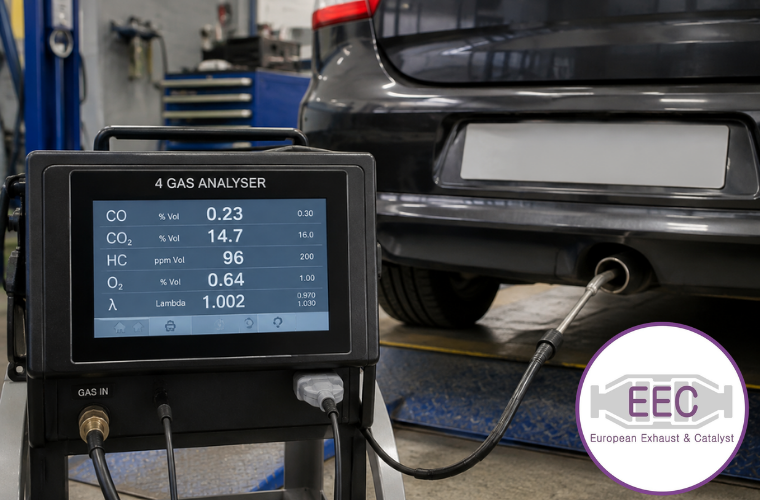
The 4-gas analyser is one of the most valuable diagnostic tools available to technicians working in the engine repair sector. Yet, despite its ability to provide a wealth of information about engine and emissions performance, it is often used simply as a way of determining whether a vehicle will pass or fail an NCT emissions test.
This can mean that valuable diagnostic information is being overlooked.
Too often, the outcome of an emissions test is simply communicated to the customer as: “Your vehicle will pass” or “Your vehicle has failed.” However, the readings from a 4-gas analyser can tell a technician considerably more about what is happening inside the engine and exhaust system.
Looking beyond the NCT test
The NCT emissions test requires readings for CO, HC and lambda. However, a 4-gas analyser also provides readings for CO₂ and O₂, and these additional measurements can be extremely useful when diagnosing an emissions fault.
For example, imagine a vehicle produces a CO reading of 0.35%, HC of 123 ppm and a lambda reading of 0.99 at 2,500 rpm. On these figures alone, it would be easy to conclude that the catalytic converter is no longer operating effectively because the CO level is too high.
Replacing the catalytic converter could bring the CO reading down to around 0.20%, allowing the vehicle to pass the emissions section of the NCT. The HC reading of 123 ppm would also be within the 200 ppm limit.
But while the vehicle may now pass, the underlying problem may still be there.
This is where simply replacing the catalytic converter can become a short-term solution rather than a proper repair. If the original fault has not been identified, the emissions levels can increase again, and the replacement catalyst could eventually suffer the same fate as the original.
The importance of CO₂ and O₂
Adding the two additional readings from the 4-gas analyser can provide a much clearer picture.
In this example, the readings could be:
CO 0.35% | HC 123 ppm | Lambda 0.99 | CO₂ 13.6% | O₂ 0.56%
The O₂ reading immediately stands out. Ideally, O₂ should be below 0.2%, yet the vehicle is showing 0.56%.
This could indicate that additional oxygen is entering the exhaust system. A small hole, damaged gasket, failed exhaust manifold gasket or even a loose manifold stud could allow air to be drawn into the exhaust system before the first lambda sensor.
This is an important finding because the additional oxygen can affect the information being received by the ECU.
If the ECU interprets the increased oxygen as an indication that the engine is running lean, it can compensate by increasing fuelling. This can result in a richer mixture, increasing CO and HC levels and potentially causing damage to the catalytic converter.
The result is a situation where the catalytic converter may appear to be the problem when, in fact, the real fault lies elsewhere.
Find the cause before replacing the component
Once the 4-gas readings indicate that an air leak could be present, the next step is to locate it.
A smoke machine is an effective way of finding exhaust-system leaks that may otherwise be difficult to identify. Using the 4-gas analyser alongside a smoke machine gives the technician a much better opportunity to identify and repair the underlying problem before fitting a replacement catalytic converter.
This approach can save both the customer and the workshop time and money, while also helping to prevent premature failure of the replacement component.
Always test after a catalyst replacement
Carrying out a full 4-gas emissions test should not just be part of the initial diagnosis. Repeating the test after fitting a new catalytic converter can provide valuable confirmation that the emissions system is operating correctly.
A new catalytic converter should be working efficiently, so if the readings remain outside the expected range, the technician has a strong indication that another fault needs to be investigated.
Potential causes can include over fuelling, air intake problems, a restricted air filter, exhaust back pressure, ignition faults, lambda sensor problems or other engine-management issues.
It is also important to check the 4-gas readings after replacing a failed coil pack. An ignition misfire can allow unburnt fuel to enter the exhaust system, creating excessive heat and potentially contributing to catalytic converter failure.
A diagnostic tool, not just a test instrument
The benefits of using a 4-gas analyser as a diagnostic tool can be significant.
Earlier this year, I presented an emissions training course for a UK Midlands free-fit and repair chain. Following the training, the company invested in a handheld 4-gas analyser for each of its sites.
Since then, their diagnosis of catalytic converter failure has halved.
This is a clear example of how better use of existing diagnostic technology can make a real difference. Rather than simply replacing a component because an emissions reading is outside the required limit, technicians can use the information available to identify the root cause of the problem.
What should the readings look like?
As a general guide, ideal readings at approximately 2,500 rpm are:
| Measurement | Ideal Value |
| CO | <0.2% |
| CO₂ | >13.5% |
| O₂ | <0.2% |
| HC | <15 ppm |
| Lambda | 0.99–1.01 |
Diagnosis before replacement
With increasing pressure on workshops to diagnose faults accurately and avoid unnecessary parts replacement, the 4-gas analyser deserves to be used to its full potential.
A catalytic converter should not automatically be considered the cause of an emissions failure simply because the emissions readings are outside the required limits. By looking at the complete picture including CO, CO₂, HC, O₂ and lambda technicians have a much better chance of identifying the underlying fault.
Taking the time to carry out a full 4-gas analysis can help prevent repeat failures, protect replacement catalytic converters and reduce unnecessary costs for both the workshop and the customer.
The 4-gas analyser is far more than a pass-or-fail testing device. Used correctly, it is a powerful diagnostic tool that can help technicians find the fault, fix it correctly and get the vehicle back on the road with confidence.
The message is simple: don’t just ask whether the vehicle will pass, find out why.